
Use this Fuel Calculator to quickly estimate your total fuel cost and fuel consumption for any Australian road trip. Enter your distance, fuel price, and vehicle details to get accurate results in seconds before you hit the road.
🚗 Aussie Fuel Calculator
Total Fuel Needed: Liters

What Your Fuel Cost Means
Your fuel cost shows the estimated petrol expense for the whole trip based on distance, fuel use, and current prices. It also shows the fuel needed in litres, which helps you understand how far a full tank will take you and when you’ll likely need to stop for fuel on the road.
When travelling with others, the trip fuel cost can be split between passengers to keep expenses fair and simple. If you’re doing a return journey, remember to double the fuel cost so your budget reflects both legs of the trip accurately.
How to Calculate Fuel Cost
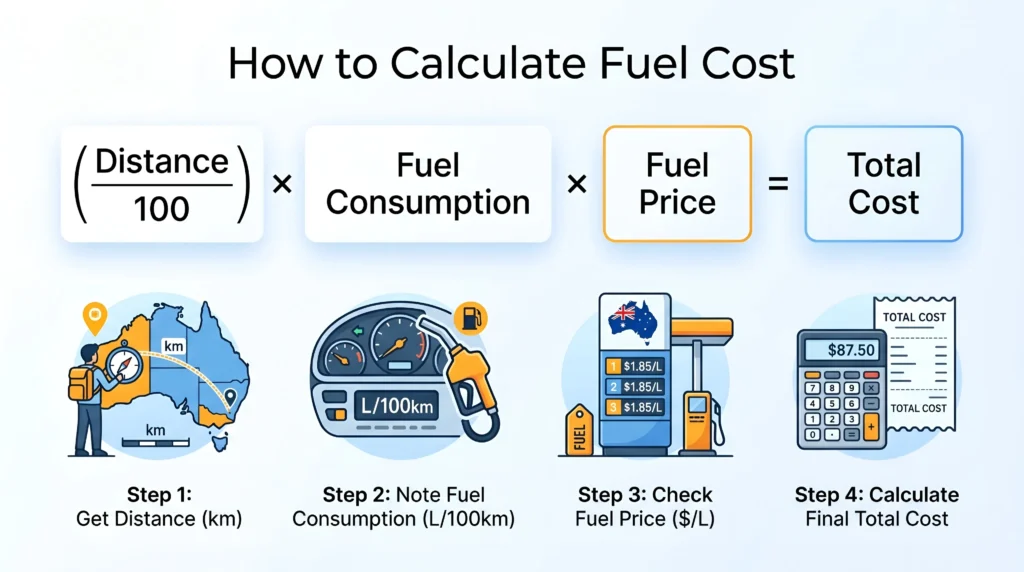
(\text{Distance} / 100) \times \text{Fuel Consumption} \times \text{Fuel Price} = \text{Total Cost}
- Enter your total trip distance in kilometres.
- Find your vehicle’s fuel consumption (L/100km).
- Multiply fuel needed by the current fuel price.
Example:
For 300 km, 8 L/100km, and $2/L → Total cost = $48.
Fuel Consumption Explained
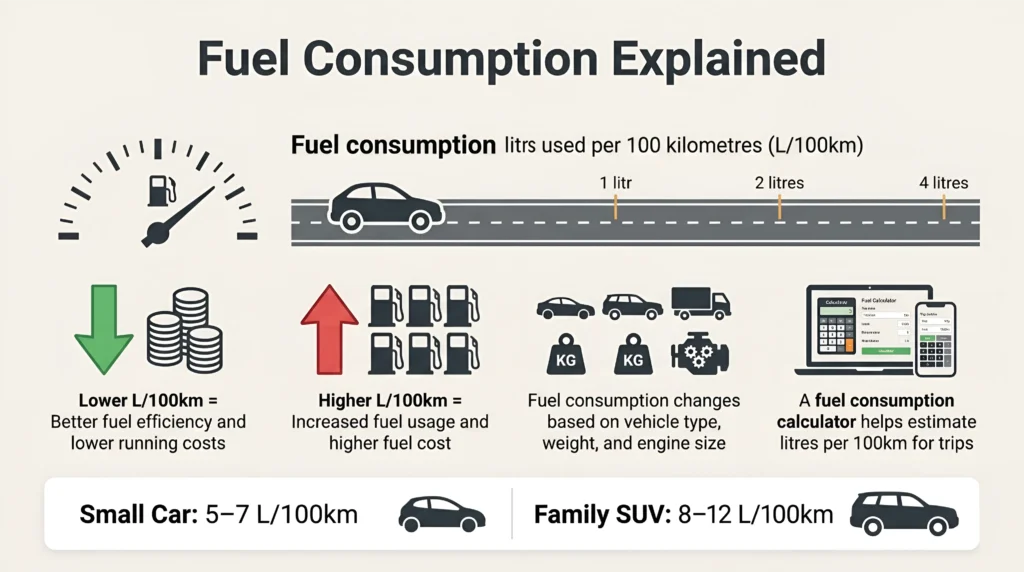
Fuel consumption is how many litres a car uses to travel 100 kilometres.
- Lower L/100km means better fuel efficiency and lower running costs.
- Higher L/100km means more fuel usage and a higher fuel cost.
- Fuel use varies a lot by vehicle type, weight, and engine size.
- Use a fuel consumption calculator to estimate litres per 100km for your trip.
Quick Example:
Small Car: 5–7 L/100km
Family SUV: 8–12 L/100km
Large 4WD/Ute: 13+ L/100km
Estimate Gas Cost for Your Trip
You can use this tool to estimate gas cost for my trip across all kinds of driving situations, whether you’re planning a weekend escape along Australia’s coastal highways, a quick run into work each day, or a full cross-country adventure between states. It works just as well for iconic Aussie road trips as it does for everyday commuting, helping you get a clear idea of what your journey will actually cost before you even turn the key. For longer interstate drives, it becomes even more useful because you can see how distance stacks up over multiple stops and regions, making it easier to prepare your budget in advance instead of guessing along the way.
Several real-world factors can change your results when using a fuel spend calculator, especially things you deal with on the road every day. Stop-start traffic in cities or busy highways pushes fuel use higher compared to steady cruising speeds on open roads, which can make a noticeable difference over long distances. Driving faster on highways also affects consumption compared to slower urban routes, while extra passengers, luggage, or even camping gear add weight that increases overall fuel usage. All of these small changes combine to shift your final trip fuel cost, which is why real driving conditions often matter just as much as distance alone.
Getting an accurate view of your trip fuel cost helps you plan better and avoid surprises halfway through your journey. When you know what to expect, it’s easier to decide when to refuel, how much to set aside, and whether a trip fits your budget comfortably. This kind of planning is especially useful for families, road trippers, and commuters who want to stay on top of expenses without stress. Instead of reacting to fuel prices on the go, you’re making decisions ahead of time, which keeps your travel smoother, more predictable, and a lot easier to manage across Australia’s long and varied roads.
Tips to Reduce Fuel Cost
When you’re out on the highway or covering long distances across Australia, your driving habits make a big difference to how much fuel you burn. Keeping a steady speed instead of constantly speeding up and slowing down is one of the easiest ways to reduce fuel cost without changing your route or vehicle. On open roads, cruise control can also help keep things consistent so you’re not unintentionally using more fuel than needed. From a mechanic’s point of view, I’ve always told drivers to avoid harsh braking and heavy acceleration where possible, because that stop-start style forces the engine to work harder and burns through fuel faster than smooth, controlled driving.
The condition of your vehicle plays a bigger role in fuel use than most people realise. One of the simplest habits is checking tyre pressure regularly, because underinflated tyres create more rolling resistance and make your engine work harder, which reduces improve fuel efficiency over time. It’s a quick check at the servo, but it can save you a surprising amount of fuel on long trips. Another thing I always recommend is clearing out unnecessary weight from your boot or back seat. Extra tools, luggage, or gear might not seem like much, but they add up and force the car to use more fuel every kilometre, especially on longer drives where efficiency really matters.
Planning ahead is where you can really save fuel without even touching the car itself. If you map your route properly and avoid peak-hour traffic or known congestion zones, you’ll spend less time sitting in stop-start conditions that waste petrol and frustrate drivers. I’ve seen plenty of trips burn extra fuel just from poor timing in city traffic alone. Another simple habit is turning off your engine during long waits instead of letting it idle. Sitting with the engine running might feel harmless, but it slowly eats fuel for no reason. Combine smart planning with these small habits, and you’ll notice your running costs drop without needing any major changes to your driving routine.
Frequently Asked Questions (FAQ)
how to calculate fuel consumption
Divide total litres used by distance in km, then multiply by 100. This gives you L/100km, which is the standard way to measure how much fuel your car uses over 100 kilometres of driving.
how do I calculate fuel average
Divide total kilometres driven by total litres consumed. The result is km/L, showing how far your car travels on each litre of fuel for accurate trip and budget planning.
how to calculate fuel efficiency
Use the full tank method: divide litres filled by trip meter kilometres, then multiply by 100. This gives a real-world L/100km figure based on your actual driving conditions.
how to calculate fuel cost per km
Divide petrol price per litre by your car’s fuel average (km/L). This gives the exact cost of fuel per kilometre, useful for daily driving and trip budgeting.
how to calculate total fuel cost
Multiply total litres needed for the journey by the current petrol price per litre. This gives your complete fuel cost for the trip before you start driving.
Who Should Use This Tool
- Road trip travelers: Plan long drives with a fuel calculator for trip costs.
- Daily commuters: Manage weekly fuel cost planning with simple estimates.
- Delivery drivers: Track fuel expenses for accurate business budgeting.
- Budget planners: Control overall fuel cost planning and avoid overspending.
- Car renters: Estimate petrol costs before starting any journey.